Wednesday, October 16, 2013

Lesson #10: Always review your archives before deleting them

They call me snapper. I'm not happy unless I've taken ten photos of the one thing. My workflow consists of this:

Snap heaps of photos experimenting with settings...
Load all onto the computer filed according to year - month - activity...
Go through, pick out favourites, sharing, WOW factor and images to edit...
Edit images and save into respective folders - facebook, flickr, blog, photography...
Start all over again...

Leaving hundreds, thousands of photos left in my archives! What to do with them? Get a bigger hardrive? Delete? I'll be honest, a small part inside of me dies when I delete photos, even if they are complete and utter rubbish! (This is coming from someone who as a child would waste a whole film on taking photos of her bedroom...and keep the photos...) but there is no point keeping photos that are blurry, exactly the same, over-exposed, too dark, or will never be looked at again.

HOWEVER, before you go and delete all those folders GO BACK AND LOOK AGAIN. Check and double check. This is not me being obsessive compulsive this is coming from experience. I nearly wiped my card once without checking. Had I done so I would have missed out on this baby.

While travelling my faithful HP computer decided to crash, hence I needed to transfer my photos first onto an external hardrive, then onto a new computer...which consequently crashed requiring a second transfer onto a third computer. In the process I somehow lost 150 photos. Gone. Have no idea what I am missing, except I know there was a lighthouse there, as well as some great caves. All I now have of these photos is this blog post. And yes, part of me is dead.

So always check and double check when deleting photos, moving photos. Not to mention, it's fun! When I went back through my archives recently, I found these little images taken on my Olympus. My Olympus u-900 is a great compact digital camera, if a little beaten up now. I still use him regularly on the water in his case, and he doesn't take too bad photos really! These were taken in my student days when we were first married and I was just starting to really get into taking more than snaps.

In the back yard - I remember liking this photo because the nodes were in focus..and nothing else!! 

Purple. Need I say more?


Sunday, October 13, 2013

Pilbara Gems: River

There are many places to camp in the Pilbara, if you are prepared to battle the rocks, the spinafex and the lack of shade. But we were delighted to discover camping in the riverbed is nearly like camping on the east coast - there is shade! 

For a weekend away, I strongly recommend finding a river and driving down it, respecting all signs, gates and fences of course, and finding a nice waterhole. You may even find a dragon fly among the peacefulness!
Our campsite - ignore the blue esky...EOS 50D, f/9, 1/640 shutter, ISO 500, 18mm.

Sleepy dragonfly - here's a tip, photograph dragonflies in the morning! They are really sluggish. Betsy (EOS 50D) f/5.6 1/200, 200mm ISO 500

Wednesday, October 9, 2013

Flooding tall trees

The Pilbara may be a dry and arid place but don't let that lull you into a false sense of security. The old saying of 'When it rains it pours' is really applicable to this place and it is not uncommon for roads to be cut due to rain and swelling rivers. Rain itself is just uncommon.

Of course, say that to a local and they generally scoff, but I think they forget places down south or over east where it is very irregular to have a month go by with absolutely no rain at all. That's just common, dreary everyday life here. There isn't even a regular, stable wet season like there is up north. There are odd patches of rain (usually a storm) and cyclones, both brought in by a low pressure system from the ocean (that believe it or not can cause nasty headaches as well).

We remember these flooding rains when camping in a riverbed. Dry most of the year, with tiny streams running through it, it is easy to forget you are actually in the bed of a mighty flood prone river. The only clue is really the bridge when you turn off, and trees like these that line the bank.

In the absence of rushing water - Canon EOS 50D f/14, 1/125, ISO 500, 28mm, manual mode polarizing filter

Saturday, October 5, 2013

Mid-Spring Long Weekend

You can't speak to anyone in the Pilbara without these three questions: 1)How long have you been here? 2) Where are you from? 3) Do you enjoy it?

Don't get me wrong, it's a great conversation starter.

People are split into three camps (generally speaking) - those who hate it but are here for the money, those that love it and are here for the money, and those that genuinely love it.

The people that hate it here are depressing and those that just love it generally scorn those who are in between. You do get really tired of people thinking you live and work in the Pilbara just because of the money, but let's fact it without the opportunities on offer here, what do you have? It's remote, it's hot, there's cyclones and virtually no shade! It's not everyone's cup of tea.

Fortunately though, I love it. It's unique, it's beautiful it's own way, the colours are amazing and as long as the cyclones behave themselves by not destroying my house I enjoy the rain.

It's the first week of October and we are heading back to QLD for a visit. Migration home is inevitable each year. We live about as far away from 'home' as you can get on mainland Australia. 'Home' is south-east QLD, a little pocket of paradise.

Further into a general Pilbara 'How do you do?' conversation, you get to the part where you talk about what you most miss about 'home' - wherever that may be. For me, I miss the green. I've had locals laugh at me, look down and me and scorn when I say that, followed by a quick retort of 'It's green (when it rains) here!' Um, yes it is but you can't sit and relax on spinafex, even if it is green! Nor does it provide shade. I think they just seem to have forgotten the pockets of paradise this country has - such as SE QLD, the Daintree, Victoria, the Tasmanian forests...They are kind of spectacular and I miss them - the dense trees, the shade, the rainforest, the damp smell.

So in honour of our long weekend back to QLD to visit family, I am posting some photos from the archives in the hopes that in my love for the Pilbara I am not blinded to the fact that there are some other beautiful parts of this country!

PS: When I say from the archives, I mean it! These babies are some of my first panoramas, taken pre-SLR.

View from one of our 4WD trips. I can't even remember if this was taken with my Olympus or my first camera, a little Kodak. I just like the green grass - that is stuff you can roll around in!

The Daintree. Where the rainforest meets the ocean. It. Is. Amazing. (panorama not so good - taken on my $100 Kodak camera when we were first married. I said archives!)

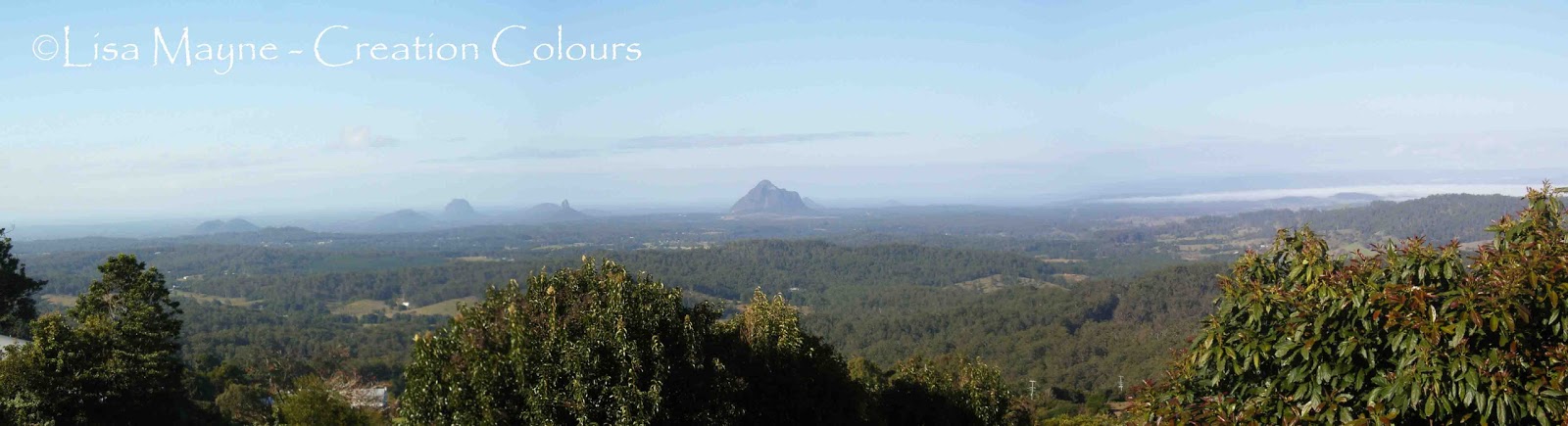
This post would not be complete without a view of the Glass House Mountains. Only a few hours drive from where we lived, this is on the Sunshine Coast Hinterland...otherwise known as paradise! (Panorama generated in-camera on my Olympus u-900)


Tuesday, October 1, 2013

Spiny hazards and prickly situations

Taking landscape photos in the Pilbara requires more than a camera and a beautiful landscape. You need to be prepared for the conditions as without a doubt you will come across these prickly sensations:
Betsy, f/13, 1/500 shutter, ISO 500 200mm
That's right, unless you are careful you will experience slow and painful death-by-spinafex!

These guys are tough. You can see they can grow out of the rock, they sneak up on your ankle when you are trying to balance and when they are green they lull you into a false sense of 'It's-ok-I'm-just-grass' security!

After a month of celebrating Pilbara wildflowers I thought I would 'point' out that to take photos of wildflowers you are constantly battling nature's pin cushions!

So, don't leave the house without long pants, preferably made from canvas, boots, gloves and any and all other forms of protection.

When not threatening you with their pointy spikes that do actually sting and itch, they are rather stunning to see covering a hill...from a safe distance.
I am Pilbara! One of many spinafex-ed hills. Betsy, f/13, 1/500 shutter 18mm manual


Monday, September 30, 2013

Wildflowers Post-Script: More Mulla Mulla

Mulla Mulla are by far the most prolific wildflower in the Pilbara, and it would be a tight coin toss as to who would win a most-photographed flower here between them and the Desert Pea. Mulla Mulla photos are a dime a dozen - from the top, from the bottom, from the side, in bunches, on their own, against the sky, against the ground...the list goes on. 

But just as a little appendix to my September of Pilbara wildflowers I thought I would share with you my first Mulla Mulla photo against the sky. This particular variety does not have as green leaves or stems, begins to lose its purple from the bottom and has more accented purple spikes. I think they are pretty spectacular.

Until next year I bid the wildflowers adieu!  Although I make no guarantees that they won't appear on this blog between now and then, they are simply too colourful!

Canon EOS 50D, f/10, 1/200 sec shutter, ISO 250, 50mm, manual, cropped, contrast and colour adjustments in Adobe RAW. Not to mention  I was on my knees, neck cricked and back hunched to get snap this sucker!

Pilbara Gems: Wildflowers - Part 5

I finish September and the beginning of Spring with my favourite wildflower. This guy is small and mighty. Small bursts of colour surround your feet, contrasting the red rocks and the green leaves. They are too beautiful for many words. Happy Spring!

Betsy, f/13, 1/250 sec shutter, ISO 800, -0.3 step exposure bias, 130 mm, shutter priority
An instagram shot I took of these fellas on top of Karratha hills - Sunset, red rocks and gorgeous flowers. Hello Spring!

Saturday, September 28, 2013

Pilbara Gems: Wildflowers - Part 4

I am a real sweet tooth. I tried the whole giving up sugar thing and it just didn't work. I love sweet things. When I go to Cold Rock Ice cream, I order lemon sorbet with skittles and or nerds. Basically a bowl full of sugar with a dash of lemon - the ultimate sweet and sour!

So when I discovered wildflowers in the Pilbara that smelled like bubblegum, I was pretty darn excited!

That's seriously what these guys smell like! Sweet bubblegum and they are purple to boot! I keep forgetting their actual name, for me they are affectionately known as bubblegum flowers. Smiles!

Aside from that, I am also fond of these guys because we first saw them when we decided to end our travels and plant ourselves in the Pilbara (yes, I took this photo two years ago, it's from the archives). We have never looked back since! These gems are a perfect example of the small, good packages that are in this place, and the good gifts that God gives to his people...just because he can.

Betsy - f/6.3, 1/400 second shutter, ISO 100, 200mm. Manual. I took numerous photos of this flower. 

Sunday, September 22, 2013

A whole lot of luck…and uncommon sense

Sometimes photographers, amateurs, hobbyists and professionals alike, spend too long looking through the lens to actually notice the world around them. This weekend I had the opportunity to go kayaking and I decided to leave my water camera (The Olympus) at home and just enjoy the morning, and being in creation rather than endlessly trying to capture the photo of the century.

I did however take my new dry bag with my SLR backpack securely tucked away from the splashes for on land later, but that’s not the sort of camera you want to take out while kayaking in the ocean. Especially not when you are chasing wildlife.

This is a wildlife story. Previously I have spoken how I do not hunt wildlife for photos (particularly birds) because they are not obliging, and apparently a woman running towards you with an SLR is a scamper-worthy sight! My motto for taking photos for wildlife is, if it moves it’s too hard, take what you can by luck, or grace.

Well as luck would have it this Saturday morning was the most wildlife prolific of our kayaking adventures. Probably because I didn’t have my Olympus or the GoPro (which has gone to a much, much more exciting cause at the moment!). Murphy likes to play games with me like that. We saw a pod of dolphins, turtles, and a massive spotted ray all within ten minutes of hitting the water.

We paddled on and spotted movement on the horizon. A pair of manta rays were cruising around on the surface feeding – a pair! So we paddle over and just cruised with them – they weren’t fussed! They dove under our kayaks, they came up right next to us, they even invited their friends. At one point we had six manta rays all within 5-10 meters of our 12ft kayaks. Largest wingspan was the length of the kayaks. We even saw two of these beauties breaching about 100m away. It was magical.

After some time, the numbers dwindled, my husband says to me ‘Hon, I think you need to get your SLR out.’ We are in the middle of the ocean, can’t see the bottom, the kayaks are rocking (although, these kayaks are pretty stable, you’d be hard pressed to capsize them) and my camera is tucked/buried in the dry bag a the front of the kayak. This means I need to edge forward, undo the dry bag, dig out my camera and move back without tipping the kayak, without letting Betsy touch either me who has had a dip already, or the kayak which has water in the bottom. We debated about it for a little while, but the opportunity outweighed the common sense of leaving the SLR in the dry bag.

I got the camera out. The Manta rays vamoosed.

Again, one of Murphy’s games.

We spotted them about 100m off. This meant I had to paddle – carefully so as to not splash poor Betsy – after them, breaking my rule of not hunting wildlife for photos. Three times we did this to no avail, they simply stopped being obliging. It was at this point that I literally started to pray. ‘God,’ I said, ‘You have created these amazing creatures, I have my camera out, please send one back for a photo!’ One of those prayers that’s like a kid asking their parent for a special treat…and sometimes they give in. He sent two of the mantas back and I started clicking madly away. Next thing this creature is right next to my kayak, I could not have asked for a better swim by. I was blown away, not only was I able to capture one of these amazing creatures but it brought home a little lesson – that God does care about the little, seemingly insignificant things and does delight to see people happy in his creation. Sometimes it’s the small mercies that make this life worth living!

It was about now that I realised, hey this guy is gonna swim right past me! EOS 50D f/6.3, 1/640 shutter, ISO 250, 120mm, manual. Polarizing filter. Adjustments in Adobe RAW

Now he is right next to my kayak! Woo! EOS 50D, f/6.3, 1/640 shutter, ISO 250, 35mm, polarizer, adjustments in Adobe RAW

Saturday, September 21, 2013

Pilbara Gems: Wildflowers - Part 3

Blue bells, cockle shells, evi, ivy, over...

We used to dance to that little rhyme in the playground, you know, you join hands and turn around. (sometimes known as washing the dishes...).

Blue bells are dainty, bell shaped flowers that for some reason always sound so posh and British. But here in the Pilbara, we have our own version of blue bells. They are not quite bell shaped, but the plants can stand head height and when the light hits them they glow and you can almost hear them ringing with colour. Gorgeous.

Betsy - f/6.3, 1/640 second shutter, ISO 800, -0.3 step exposure bias, 200 mm.

Wednesday, September 18, 2013

Discovering the New

Have you ever met those people who can just find stuff? $20 note? No problem! Rare animal? Sure! Satellites at day time? What's so hard about that?

Well, I'm not one of those people.

I'm always the last to see, hear, do anything. So when we were out camping on the weekend, and I spotted a wildflower I'd never seen before, I made my husband stop in the rocks so I could run out...in my socks among the thorns...to take a photo, thinking I had struck something amazing - a wildflower I had never seen before that was redder than the rocks!

Canon EOS 50D (Betsy), f/18, 1/250 sec shutter, ISO 500, 200mm, manual mode with polarizing filter. Contrast, brightness and white balance adjustments in Adobe RAW. 
Turns out, there were quite literally squillions of these things in patches dotted up the riverbed. The seeds must be carried down when the river is in flood and deposited in small patches - they only grew in the river bed and I have never seen them anywhere else!

I tell you what though, the red was absolutely stunning! It made me think of the Poppy scene from the Wizard of Oz. I even started yawning! If anyone knows what these lovelies are, I am all ears.

Like I said, a more vibrant red than even the rusty iron-ore clad rocks! Betsy, f/18, 1/250 shutter, ISO 500, 20mm, manual mode with polarizing filter. White balance, contrast and vibrance adjustments in Adobe RAW
P.S. If I find out these are weeds, I will surely die!

Saturday, September 14, 2013

Pilbara Gems: Wildflowers - Part 2

Of course, you can't focus on wildflowers without a nod to another of the region's most prolific and definitely one of the most impressive flowers I've ever seen. Sturt's Desert Pea is technically the floral emblem for South Australia however in our travels the place where desert peas were most prolific is here. It is astounding. They are like tongues of fire spreading across the ground.

Betsy, f/10, 1/800 shutter, ISO 500, -0.3 step exposure bias, 50 mm, shutter priority

Betsy - f/14, 1/800 second shutter, -0.3 step exposure bias, ISO 500, 130 mm,  Shutter Priority
I must admit, I am a little obsessed with these little gems - they are stunning! I can't count how many times I have taken pictures of these. What is particularly remarkable about these guys, is that they are not always black and red...more of that to come!

Sunday, September 8, 2013

Pilbara Gems: Wildflowers–Part 1

September is the time of year when Western Australia comes alive with wildflowers – well, most of it anyway. Most people may think of the wildflowers down the south west corner – kangaroo paw and the like. Here in the Pilbara though, the wildflowers bring life and colour to the otherwise arid, spinafex covered landscape. And we aren’t just talking one or two here, no. A whole sea of colours – pinks, yellows, oranges, whites, blues, reds, blacks, maroons, purples, greens, browns…just to name a few.

In celebration of September and the coming of spring (ignoring the fact that we are already getting days above 35 degrees Celsius) I would like to highlight some of the incredible and unique flowers that have graced the landscape.

To begin with, I would like to focus on the Mulla Mulla – purple at first glance, but upon further investigation are full of different shades, as well as whites and contrast nicely with the green leaves.

Betsy, with f/8, 1/640 shutter, ISO 500, -0.3 step exposure bias, 200 mm, shutter priority. Taken in the morning and displays the wonderful way these flowers grow and their prolific nature.  


Betsy, f/18, 1/320 second shutter. ISO 500, -0.3 step exposure bias, 185 mm, aperture priority. My favourite point of view of the Mulla Mulla. 
Mulla Mulla are likely the most prolific where we are. They do come in shades of green and white. There are also a number of different varieties that are different shades of purple. When they grow, they get longer and longer and they are surprisingly soft.

Wednesday, August 28, 2013

Playing with Colours

A whole new world has opened up to me with editing RAW photos and playing with colour hues, gradients, balance and levels. On the one hand I feel they create a much more dynamic feel to the photo, but on the other hand other hand, some colours are lost in the process. Particularly in sunset shots. Numerous times I have edited a sunset photo, and when compared with the original, the range from orange to blue has lost its complete gamut. Still, it's an enjoyable past-time, although it is increasingly becoming apparent that proper training is required, although sometimes when you edit, you just feel your way. Most photos are over edited in my opinion anyway.

Check out this photo I took at Point Samson recently. The light was perfect - the hour before sunset, but that didn't stop me increasing the magenta hue to add a touch of purple. It's no secret that purple is a personal favourite of mine!


Canon EOS 50D, f/5, 1/32000 second shutter, ISO 500, 18mm, three shots stitched to form panorama. White balance and colour adjustment in Adobe RAW

Saturday, August 24, 2013

Lesson #8 & #9: The remote, the lens and explosions of colour

There are few moments in life where one can sit back and do absolutely nothing and be entertained completely at the expense of others. I am of course speaking literally here – sitting back at a show that has free entrance, watching a fireworks display. I shudder to think how much money these explosions of colour cost, but my goodness are they fun to watch! They are also particularly fun to photograph, as I found out a few weeks ago.

I have had grand intentions of photographing fireworks in the past with zero success – this year is the first opportunity I have fully taken advantage of. I packed my Betsy, my tripod and by the grace of God, my remote.

We set up in amidst throngs of people underneath huge oval spotlights that I confess, had me worried. I set my camera at a 30 second shutter speed, wide aperture and waited for the show.
The lights dimmed, the first spark went up and it was on.

After three explosions it became clear that 30 seconds was going to be way too long. I set it back to 6 seconds. Again, too long. Some fireworks were clearly brighter than others. A single setting for all was not going to work, and I didn’t want to waste time changing settings, especially when you have no idea what is about to explode overhead! How to fix this? Light bulb moment – almost literally – BULB!

Enter lesson eight: With my remote and the shutter set to Bulb I could press and release as I pleased depending on how bright each blast was. I had to adjust the aperture several times, but towards the end managed to get the hang of the timing of the show and came out with some crackers. The best part? I was able to sit back in my comfy camp chair, watch the show and just press and release my remote! Honestly, most enjoyable way to photograph something! It became an awesomely fun challenge to get the timing right.

Of course, each silver lining comes with a dark cloud. The day before this glorious revelation we had been at the beach. Enter lesson nine: Clean lens after taking Betsy to the beach! Due to some salt spray on my lens, many of my firework photos were rendered useless! Luckily some were not bright enough to make the salt spots shine, so there are a number of usable ones.

So I got a little carried away with how many to put up here, but there were many lessons and many different types. This shot I think is awesome, but for the spotlight in one corner and the salt spot on the other side. I love the shine in the middle and the almost reflection of the two fireworks. Canon EOS 50D f/16, 7 second shutter, ISO 500, 18mm.

Two different types here, great patterns. Small salt spots on the bottom though which is a shame. EOS 50D, f/16, 6 seconds, 18mm.

These guys were interesting. When you watch them they appear as dots of light. When photographed they appear as feathers. It's so much fun. EOS 50D f/22 ISO 500 18mm.

The difference the shutter speed makes - same style as two above, but this time the shutter is only 1 second. EOS 50D, f/22, ISO 500 18mm. I think it looks like a protia flower.

Blue seemed to work well as it was not bright enough to light up the salt spots. Plus there were no fireworks underneath this one which helped. EOS 50D f/22 2 seconds, ISO500 18mm

Probably my favourite because of the different colours and the glitter effect of the gold. Canon EOS 50D, f/22, 2 seconds, ISO 500, 18mm


Not bad for a first time photographing fireworks though! It may not be natural creation, but they are still a creation of colours, and a whole lot of fun!

Just a note that all these images are edit free other than cropping. I needed the full 18mm to capture the whole diameter but it left a lot of dark space that required cropping. Not to mention the salt spots!

Wednesday, August 21, 2013

The Beautiful Desert Rose

One thing that I have always admired about creation is the decorative colours flowers provide. I may be a shocker when it comes to naming a species, but when it comes to admiration, I have it in bucket-loads.

Western Australia is famous for its flowers – this is a well established fact. Not many people think of the Pilbara when it comes to flowers though. The truth is that there are numerous vibrant examples of unique and wonderful natural decorations up here. Some are cultivated but most grow like there is no tomorrow a couple of months after rain.

I may produce another post dedicated to the Pilbara wildflowers, however this one I just want to focus on one flower that is common in pots and gardens up here – the desert rose. I have one, that hasn’t flowered yet, but they are prolific in town green-space and facilities as well as private gardens and they are stunning splashes of pink against strong green with a hardy stem.

I photographed one at a small museum last weekend, and was once again quite amazed at the difference editing the RAW file made. Colours are vibrant and the clarity better. Your can adjust the white balance to ensure maximum impact of colour. The image below was considerably more red in the original. Increased contrast and tweaking the tint to make the image warmer with a slight magenta hue worked wonders.

Canon EOS 50D f/5.6 1/8000 shutter, ISO 500, -1.3 step exposure bias. 70mm. Colour adjustment in Adobe RAW

Saturday, August 17, 2013

The Original Kodak Moment

Remember what I said about not taking photos of anything that moves? Well, sometimes life presents an event that you either say “I wish I had my camera in the car right now!” or “I’ve got to do anything to I can to get a photo – the opportunity is too great!” I call it the Original Kodak Moment. Or making your own luck. Or putting yourself in silly situations just for a photo.

One such moment presented itself on the weekend.

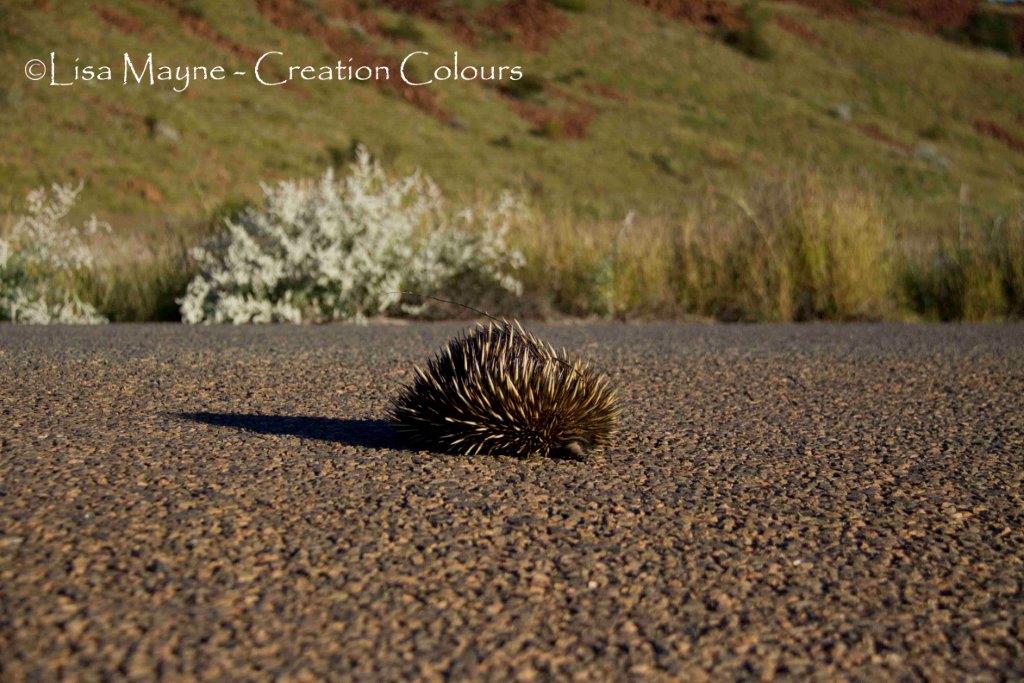
I was driving my little car along an outback road, when suddenly my tires nearly burst thanks to the little guy below running out onto the street! I slowed down, the guy coming the other way stopped, and I raced out with my camera, and my grandmother’s camera who was visiting at the time. Of course, I wasn’t first to the scene of the terrified echidna, but I think my Betsy managed to intimidate the other onlookers a little…oops, that’s really not meant to happen!

So here I am, crouched down on a road where the speed limit is about 80km an hour. It’s a popular road on a weekend as it leads to a nice little cove. Two cars had to swerve to the other side of the road to miss me. I’m sure they thought I was quite mad but let’s face it: you don’t want to hit one of these guys with your car!

Pilbara Echidna. Canon EOS 50D f/4.5 1/6400 shutter, ISO 500, +1 Step, 50mm, shutter priority setting. So this picture is boringly composed - who puts the subject almost of dead centre? - but I like it because it shows the echidna literally in the middle of the road, with the gorgeous Pilbara colours behind and even a bush of some wildflowers! Plus I like how the echidna is in focus. Why does he have a stick on his back I wonder? Fancy Dress? Not likely.

Canon EOS 50D f/5.6 1/6400 shutter, ISO 500, +1 Step, 110mm, shutter priority setting. I like the shape of the echidna in this picture, and the pattern his spikes make. I'm still confused about the spike - I wasn't game enough to remove it on the day, I'm a chicken! The only thing that could have improved this picture is getting his eye. I only caught a brief glimpse of it, but my father always said when photographing wildlife, get the eye in focus or else it's worthless! And the threat of speeding traffic should be no excuse, not to the real amateur photographer!


Normally I would remove such a gorgeous creature out of the way on my departure (generally by chasing it, yes) but to tell you the truth I was a little intimidated by those spikes! When left alone however, he quickly scampered off into the bush so no harm done. Well other than the fright of its life!

At the end of the day, if it moves it’s difficult, but if it refuses to move out of shear fright it’s fair game!

Saturday, August 3, 2013

Chasing Egrets

I’m not one for patience when it comes to photographing wildlife. I have a rule – if you can’t sneak up on it, don’t bother. This is because whenever I do bother I manage to scare the animal, bird or insect away. Rule one basic photography – anything that moves is difficult!

I rely on the ‘right place, right time’ principle. And luck. Not a lot of it comes my way to be honest.
We took a little adventure on the weekend to a waterhole by the highway. One of those places that exist in the realms of mud-maps with ‘turn-left-at-the-jerry-can’ directions.

So, the gorge was gorgeous, and we were spoiled with a wildflowers and bird-life. Several flew overhead, hid behind rocks and dove for fish. Of course I was waiting for my husband who was busy spraining his ankle, so I decided I might just do a bit of bird chasing.

Let me tell you how this normally goes: Bird flies over, lands just out of reach of the 200mm, I stand quietly, reach for the camera…and the bird flies away. If I am lucky enough to have the camera on me, is sneak, then snap, snap, snap while whatever I’m photographing flies, runs, scampers away. Normal results are nothing.

This particular day however, a couple of egrets flew over. After two attempts of sneaking up, I kept the camera close by. One of my snapping sprees yielded this. 

Canon EOS 50D f/5.6 1/6400 shutter ISO 500 +1 setp 150mm. Cropped. Shutter Priority
 The cropping diminishes the quality, which is a shame. It has been heavily cropped, and colours slightly edited and enhanced in Photoshop RAW.

Saturday, July 27, 2013

Instagram & Karijini - Match made in Heaven?

I know I've written about Instagram before. It is a marvelous program that seems to have the ability to turn every photo into a masterpiece. Nearly - it doesn't seem to work that well for me.

It does seem to bring out the colours of Karijini quite nicely.


But it does frustrate me a little bit. OK, more like a lot. I'm not sure why, it just does. It's given terrific photos to your fingertips - instantly - but you can't actually do anything with them! They are too small to print, they are square, and I get really tired of the presets.

Have I mentioned how great it is for Karijini though? It does do a marvelous job of highlighting the colours, enhancing the shadows an creating interesting images.

Monday, July 22, 2013

Pilbara Gems: Python Pool

The landscape of the Pilbara is vast and arid. There are continuous subtle changes for those driving for more than an hour that may go unnoticed to the unappreciative eye. For those willing, there are a number of small but precious gems scattered across the region.

Python Pool is one – situated in Millstream-Chichester National Park, it is a local haunt when it has had a flow. Sure, it’s not the grand canyon, it’s not even Karijini, but for a relatively short drive, it’s refreshing.

Not to mention the drive out there is spectacular. I am planning a trip out there soon – we have had a lot of rain and I can just imagine the wildflowers that will be gracing the roadside!
My last visit to Python Pool was in April this year. I am only showing you the photos now because I was about to format my card when I realised  I hadn’t backed these ones up yet. Always, always double check!

Python Pool. Canon EOS 50D (Betsy) f/3/5 1/400 ISO 200 +2 step exposure bias 18mm, shutter priority
Dragonfly Python Pool. Canon EOS 50D (Betsy) f/5.6 1/400 ISO 200 +2 step exposure bias 200mm, shutter priority


Dragonfly Python Pool. Sitting on my camera bag. Canon EOS 50D (Betsy) f/5.6 1/400 ISO 200 +2 step exposure bias 200mm, shutter priority

Friday, July 19, 2013

How to Harass your Husband

I am in no way, shape or form, an early morning riser. My husband calls me a morning zombie. I do not function without coffee and even then it takes a good hour for full brain functionality to flow.

We recently purchased some kayaks, one thing I have always wanted to do. In order to fit it into our busy schedule last weekend, we decided to ditch cleaning the house on Saturday morning and go kayaking instead. This of course meant getting up at 6am. At the moment, this requires rising before the sun, which according to myself, humans are not supposed to do.

We trundled out to Cleaverville Beach, which is midway between Karratha and Roebourne. It’s known to be infested with two things – flying creatures that bite you and grey nomads.

We pull into the ‘boat ramp’ (that is, a muddy gap in the mangroves) and I immediately start helping my husband unload the kayaks…or would have if I didn’t have Betsy in the car and decide a better use of my time was taking advantage of the early morning sun. I so rarely get to see the light after sunrise due to my not-so-rare condition!

This of course is a perfect way to annoy your husband, especially one who was up half an hour before you packing the kayaks. My photography adventures with him are all about balance – photos, being with him. Hence, on this occasion, not too many photos were taken. I tried to be a good wife.

Cleaverville Boat Ramp. Canon EOS 50D (Betsy) f/3.5 1/8000 shutter, ISO 500, +1, 18mm. Cropped. Edited in Photoshop Adobe RAW

Canon EOS 50D (Betsy) f/3.5 1/8000 shutter, ISO 500, +1, 18mm. Cropped. Edited in Photoshop Adobe RAW

Sunday, July 14, 2013

PS: Pirate Instagram

Just as a postscript to the previous post, I also snapped this Instagram of Pirate Cove, just to prove how impressed I was with the colours! (I was also impressed there was phone reception there…not so remote after all!)


Saturday, July 13, 2013

Pirate Panoramas

Arrr, She’s at it again!

I finally have a weekend where I can sit down on a Saturday morning, drink my coffee and edit my photos. Unfortunately I haven’t been out much taking photos lately. To tell you the truth, I’m struggling to find new inspiration. There are only so many times you can climb the Karratha Hills and take photos of the sunset!

Last month I had the opportunity to go out on a charter boat to some of the islands of the Dampier Archipelago for a social function. Of course I took Betsy with me, despite the threat of rain. I must confess, I took some okay photos of the local rock art, but I am unsure of whether or not it is appropriate to post them on here. You may see those pop up in the near future, but for now I will focus on the shots I took of a place called Pirate Cove.
We climbed the rocks and there were some amazing colours. I’d wager you would be hard pressed to find these colour combinations anywhere in the world – Iron rust red, sandy yellow, ocean blue, mangrove green, black and grey all contrasting stunningly with the turquoise water. It’s spectacular.I was left behind by the group at one point (this is actually a frequent occurrence!)

This series shows some experiments – and that there are a number of ways to skin a cat.  Some are better than others. All edited in Adobe raw, with presets for the stitching, they still don’t quite fit together which is unfortunate. The sun just didn’t do as it was told! Which one is your favourite?

Also bear in mind I was clambering over unstable rocks…in bare feet. Real smart.

Canon EOS 50D (Betsy), f/3.5 1/800 sec ISO500, +1 step exposure bias, 18mm. Auto white balance, Shutter Priority mode. Five portraits stitched in Photoshop. Edited in Adobe RAW to enhance colours


Canon EOS 50D (Betsy), f/3.5, 1/8000 sec shutter, ISO 500 , +1 step exposure bias, 18mm, shutter priority. Two landscapes stitched in Photoshop. Edited in Adobe RAW to enhance colours.

Canon EOS 50D (Betsy), f/3.5, 1/8000 sec shutter, ISO 500 , +1 step exposure bias, 18mm, shutter priority. Two landscapes stitched in Photoshop. Edited in Adobe RAW to enhance colours.This is slightly crooked. Oops.

Canon EOS 50D (Betsy), f/3.5, 1/8000 sec shutter, ISO 500 , +1 step exposure bias, 18mm, shutter priority. Two landscapes stitched in Photoshop. Edited in Adobe RAW to enhance colours.This one will annoy you when you see it. I'm not going to point it out. But it's annoying. Very annoying.

Saturday, June 8, 2013

Under the Sea

I know I have been pretty slack in this blog lately, but let me assure you it is due neither to lack of passion, or too much Dr Who! I have been unable to access the internet much from home lately as we used most of our bandwidth downloading a CyberLink program to edit GoPro footage. It's fun, but time consuming.


Printing on Canvas

There is a lot more to producing high quality photos for a wall than what people realise. When I had an old film camera I never gave the developing process much thought – you gave the chemist your film, paid him, and an hour later ta-da! 24 photos.

I have in the past used Photobookshop.com.au to get myself some photobooks. I even turned my previous blog into a photo book. I like this company because they are fast, high quality bound and Australian. Not to mention the knock out deals you can get when you purchase their vouchers. So when I saw them advertising canvas prints at a discounted rate of 70%. Bargain! I selected four of my favourite landscapes. I bought four vouchers, uploaded my photos and thus began my anxious wait.

They arrived beautifully mounted and a lot larger than I anticipated. However it was soon very clear that the pictures appeared a lot darker than they did on my laptop screen. Colour calibration is not something easily done when sending files to the east coast. Note to self – take more care when preparing files for printing. Where possible, ask for a proof or something. Or have it done locally…20130608_16312520130608_16321520130608_163200

Sunday, May 5, 2013

Karijini the third: Panoramas

I love panoramic photography. I have done since I saw a panoramic picture my Pa took of the Back Beach in Mornington Peninsula - this was five photos placed next to each other and framed, and I just thought it was the coolest thing!

Then of course, as you grow older you soon come to realise the King of panoramic photography is Ken Duncan - Check out my favourite photo of his. Guess where?

To capture so much information, what you are seeing is a huge challenge, especially when it requires photo stitching. I started panoramic photos when I had my first digital camera - a little Kodak. I stitched them together with a free program, Arc Soft, that came with a memory card I purchased.   The results were reasonable, maybe I'll share them with you sometime, but it was clear from the start several techniques and pieces of equipment were required - tripod, a straight horizon and even lighting.

So in our recent journey to Karijini, a place where there are simply too many places to look, I had a stab at a few panoramic images. This is tricky because of the cast of light and shadow in the gorges - exposure is a hard thing to get consistent so most of the successful pieces are actually only two photos stitched together. The ones below are the picks.

Circular Pool - Dales Gorge, Karijini National Park. Canon 50D, f/3.5, 1/200 sec shutter, ISO 250, polarized lens filter, 18mm focal length, four portrait images stitched.
 Circular pool is a fantastic place to swim, and we were blessed with the lighting when we got there - the sun was reflecting off the opposite wall and onto the red rocks behind the pool creating these amazing oranges and reds! I've found with panoramas it's good to take portrait photos instead of landscape. As you can see in the image below, too many landscape photos stitched together and the image becomes quite thin. The image above is four portrait photos, below is three landscape photos.

Karijini National Park, Pilbara. Canon 50D, f/4, 1/4000 sec ISO 250, Exposure bias +2 step, 35mm focal length, three landscape images stitched
The golden hour - as we were driving home from a day of gorging the sun was setting, casting golden light on everything. The golden hour in the Pilbara is pure magic.