Showing posts with label precarious situation. Show all posts

Saturday, October 8, 2016

Having a Whale of a Time

I'm not really putting much thought into these titles am I?

We bought the boat towards the end of last year. I've written about how it helps you to escape the Pilbara Summer and some of our other adventures on the boat. But finally, I managed to go out on the boat to see the whales.

The water is teaming with them at this time of year. It's almost like you can't go out and NOT see any whales.

But talk about precarious situations. Our boat is five meters - so not that big. And I had a two month baby in my arms the whole time. A two month old baby, trying to keep him calm while taking photos of whales with my zoom - meaning you have to keep the camera REALLY still when zoomed - while on a rocking boat. Yeah, it didn't work PARTICULARLY well, but still managed to snap a few.

I ended up using the shutter priority and really ramping it up to about 5000 or so to try and freeze the motion of the whales. The tricky part was getting them in focus. I had the auto focus on which really helped but was not perfect. It got tricky-er when I realised that my replacement camera, the 70D, can film so I decided to try for some footage as well, but needed to turn the autofocus off for that because it kept shifting between the boat, the whales and the water. All in all it was quite ticky, but managed to snap a few. If only we could get a bit closer or I had a bigger zoom...and the baby was old enough to sit on his own. Next time I go out, I'll go out with grandparents who I'm sure wouldn't mind holding bubba for me...

Another example of when a zoom lens REALLY comes in handy...


Sunday, November 1, 2015

Close Encounters

My mother in law is a real go-getter.

We went for a walk up the other end of the beach at Eco Beach one morning. The landscape was completely different, with more of your traditional beach colours.

The tide was rapidly approaching - WA has massive tides, bigger the further north you get (Derby, right at the top has 10m tides...). While walking, a channel started to form between us and the shore. We soon realised that this channel was filled with baby shovel nosed sharks! These guys blended in with the sand but would soon scoot off if you got too close. They scooted everywhere, even over our toes at times!

We were happily enjoying these precious little ones, when we spotted something that was rather larger...a shark, yes. Hopefully, from my research done later, just a gummy shark (as it has two fins) so therefore not a bitey one, but it's not the sort of thing you want to take chances with! Thank goodness for the 18-200mm zoom so I could prove our bravery.

Although I must admit that while my mother in law wanted to swim I requested that we move out of shark territory before we do so - I'm a bit practical when threatened with a chunk bitten out of my leg. My mother in law wins the bravery award for wanting to swim in shark territory.


Sunday, August 9, 2015

Face to Face with Death - All 10cm of it

There are often jokes made about all the things in Australia that can kill you.

Snakes, spiders, crocodiles, sharks...drop bears...

Then, if it doesn't kill you, it will likely bite you and make you itchy, or poison you, or make your hand swell up like a balloon.

Let's face it, we may not have any of 'the big five' or carnivorous land dwellers, but Australia is a pretty scary place.

One of the things you always hear about is the blue ringed octopus.  This sucker, with is eight tentacles of suckers can kill you in three minutes. In a really horrific way. It's one of those things you always hear talked about but never see...like drop bears.

Until you see two of them at Point Samson while out reef walking.

Thank goodness I was actually in shoes this time.

We were with my sister and brother in law who were visiting. My Brother in law spotted the first one - and kept him out of his hidey hole with a rock until I could get there with the macro. Inches away from death. And this creature, I kid you not, was no longer than 10cm and the most vibrant blue rings I could ever imagine! The Blue rivaled glacier blue, it was almost fluorescent! We had fun taking photos, from a relatively safe distance. It was just a shame that my husband didn't see it - he had decided that he needed to confirm that there was indeed nothing at the end of the spit.

But, we did spot another one in the end. If you head over to my Instagram feed, you can see a short video I got of that one, and you can see his blue rings pulsing - getting brighter, even darker around the edges as he gets scared.

I have never been more grateful for the macro. They swam very fast but I managed to snap a few.

My Favourite - Blue Ringed Octopus cruisin' - giving these humans the evil eye

It's a pity the tentacles are out of focus in this one, but I love his eyes

One of the most fascinating things - other than the potential for a 3 minutes of excruciating death (unless someone basically performs CPR for 24 hours...) - is that the rings get brighter, but the skin around the rings also gets darker to make them stand out even more...you really can't say the don't warn you.

Sunday, November 23, 2014

The Seascape

Seascapes are beautiful in that they combine the early or late light of sunset or sun rise, with the dependency of coastal rocks, and the fluidity of the waves crashing into them. They are stunning.

While camping at Warroora I had the perfect opportunity to capture my first seascape. In honesty, this is my second attempt - the first ended in zero results but a lot of lessons. The first of those being not pointing the camera directly into the sunset (sunrise is too early for me) - the light overexposes when the shutter is left open to create the mist. I suppose this would be easier on the east coast where the sun sets away from the water. But here on the west we are left with the conundrum of trying to have the light to our back or to the side to light the rocks but not overexpose the centre.

The first attempt at Maggies didn't feel like it went well - however I was pleasantly surprised by my photos when I returned. I liked the ones I took on the first night more than the ones on the second. The second I sought high ground on the rocks to avoid having to rescue my camera and tripod from freak waves - based on experience!

Taken the first night. Exposing the dark sections was the trickiest part - done in photoshop. Also, cropped to make a more pleasing composition. Canon EOS 50D f/22, 0.8 seconds, ISO 200 10mm. I kept the ISO down to reduce the noise. 

I like the mist in this once, but the noise due to the low light is a problem. Canon EOS 50D f/22, 20 seconds, ISO 200, 19mm

Taken the second night with the sun behind me. You can just see our camp. Canon EOS 50D f/9, 8 SEconds, ISO 200, 10mm. I tried to improve composition, and escape the waves by seeking higher ground but the impact is less. 

Sunday, October 19, 2014

The Slippery Spa

It is a rare occasion that I wake up early, let alone get up to see the sunrise. On this particular morning, I did both (largely because we were camped in a swag and once it was a teensy bit light I wanted to be up and out).

Photographs of the sunrise will come. This post is about the difficulty of traversing Hamersley Gorge and its folded rocks to reach the spa pool and shoot it before the sun crept over the gorge wall and polluted the scene with its light. (Bit of a strong description there, the sun's not all that bad!).

The spa pool is one of the most photographed pools in Karijini - it's stunning. Ken Duncan's shot it, this guy has, Ben Knapinski who is responsible for many of the Pilbara and Kimberly post cards also has a shot, as well as any other photographer - Pilbara or otherwise - who has visited Karijini. Basically, I didn't want to miss out. Some say photography brings out my competitive side. Well, maybe, but I also like to think it brings out the inspirational side as in "This place is beautiful. Look at what these people achieved! Can I do that? Let's give it a go!"

I had the 4WD boots on for this adventure. No bare feet, this was serious business!

We reached the pool. My husband took himself off adventuring further up and I placed my backpack precariously on the rocks. Let me tell you something about where I am standing - the rocks have been folded so that while they are flat they are not horizontal. Anything but! Completely uneven ground, almost impossible to make sense of.

Luckily I had my trusty $30 tripod with me. I set up, making sure that there was no chance of the camera crashing to its death on the rocks, or drowning in the deep pool. This meant I would press the button, while guarding the tripod as if my life depended on it by encircling it with my arms without bumping it. All the while having my feet in bulky boots, balancing on these incredibly uneven rocks. I changed vantage points many times as one side of the pool was already becoming more and more exposed to the sun. I also wanted to avoid the overexposure of the background. I could have experimented more with HDR I suppose, but I haven't had much success with them in the past.

Eventually it got to the point where I had to jettison the boots as they were more slippery than they were help, go barefoot into the slippery, mossy channel and crouch down for balance so I was basically sitting in the water with my camera and a deep pool in front of me. Precarious. I have never been so nervous about dropping my camera! The sun was creeping further and further into my frame so eventually I conceded that if I didn't have the photo already, it wasn't going to happen that day.

Fortunately I did manage to snap a couple I am happy with. Check it out.

Canon EOS 50D, f/14, O.8 seconds, ISO 100, 18mm, (10-22mm Canon Wide Angle)

Canon EOS 50D, f/20, 2.5 seconds, ISO 100, 10mm (10-22mm Canon Wide Angle)

Canon EOS 50D f/22, 2.5 seconds, ISO 100, 16mm (10-22mm Canon Wide Angle)
Pretty happy with these. A shout out to my husband who drove me here and put up with me photographing these spot for at least an hour before he could go for a swim. He's a legend. It was a 275km drive to Hamersley, I was up before the sun, and spent an hour shooting on completely uneven ground in one of the hardest positions I have found myself in. Worth it? Definately. The things you do in the Pilbara.

Sunday, June 1, 2014

A Tale of Two Pilbara Symbols

There are many things that symbolise the Pilbara for me. This is one of the reasons this place is a wonderful place for photos. Everything has a meaning and a story to tell.

When more than one symbol connect, the picture created is even better.

One of these symbols is the sunset. They are truly magnificent in the Pilbara. I am of the opinion it is because of the vast open spaces, giving plenty of space to God to create his canvas of colour. We can see the big picture, with no buildings or structures interrupting our view. Just clouds of colours.

I hear that the best way to photograph sunsets is with a split filter. I have split filters, but have not yet used them much as I keep forgetting that I have them...oops. But in this case, it would have been tricky as I was photographing a sunset with another Pilbara symbol - the iron ore train.

One of the longest trains in the world and I would guess one of the most valuable. Literally millions of dollars are rattling by when they go past. Train tracks spread across the country as far as they eye can see, and waiting at a crossing for one of these bad boys to go past is not uncommon.

Thus sets the scene for this story. On our way home from Millstream one day, the sunset just got better and better, until I convinced my husband it would be a good idea to pull over. Luckily our friends in the car ahead had the same idea. We pulled off to the side of the road where we had one of these vast views and started snapping away. We realised that although we had a great view of the clouds, we could not see the horizon due to the railway track mound. When climbing on top of the ute didn't suffice, we decided to run to the track to see if we could get a better vantage point.

Rain is scarce in the Pilbara, but we had had some that week. Unfortunately, as nice as the rain it it usually means one thing for the Pilbara in the following weeks - insects. We ran towards the track, hit a mud patch with small stagnant pools. It was here that we were set upon by the most violent mosquito attack known to mankind! One swipe down your arm could kill up to 15 mosquitoes at a time, but that didn't stop the little critters from attempting to eat us alive! I am sure they were starving, and saw us as their salvation. They followed us all the way back to the car and we spent the remainder of our trip scratching every patch of bare skin as each one was covered with bumps and bites.

At least I managed to snap this baby. A split filter would not have helped in this situation due to the silouette effect, and I had to crop some power poles out, taking away the wide angle effect, but in the end, I love what it symbolises - The Pilbara. Mosquitoes and all.

Canon EOS 50D, 10-22mm Wide Angle lens. f/5, 1/200, ISO 250, 21mm cropped. Slight enhancements in Photoshop.

Wednesday, May 14, 2014

The Macro, Depth of Field and handheld photography...while balancing on Pilbara rocks...

...in bare feet.

What is the photographer's ideal when sighting a new wildflower to snap? Perhaps, having a macro lens already attached to your camera body, and that body already attached to a nice sturdy tripod that you can set up perfectly, not a breath of wind and good solid ground to stand on to get a good view in the viewfinder.

HA.

Welcome to the Pilbara. More specifically the Burrup Peninsula which is covered in rocks. Mounds of rocks. And that grass in between? Spinafex. What do I do when I go kayaking up the Burrup? I take my camera...and no shoes.

Here I am, climbing a rock mountain to test out my wide angle lens...in my thongs that I decided to ditch because they were more trouble than they were worth. I take an ordinary photo of the bay, and start to amble down when I stumble across a purple flower I had not seen before. You beauty! Luckily I had the macro in my backpack. Upon sitting down to change my lens however, I discovered not a skerrik of flat rock to keep one lens while I took the other off. I only have two hands, one of which has to hold the backpack and my thongs, the other that has to hold my camera, all the while unscrewing a lens, unscrewing the macro dust cover, switching the lenses, re-screwing everything, all the while not dropping anything to its certain death down the rock hill.


I achieved the impossible and miraculously managed to change to the macro without a single crash. So I set about trying to shoot this purple flower. Tiny they were, under a centimeter across. I had no tripod with me and there was a slight breeze. At 100mm, a slight breeze is all it takes. I don't know how long I sat on that uncomfortable, unlevel rock, precariously clutching my camera at all focal lengths trying to get the depth of field just right...only to have a breath of wind breeze past moving the flower just far enough out of focus to ruin my shot. Incredibly frustrating. I employed a quick shutter and patience....and many many photos. (I had to stop and delete some off my full card...twice). Eventually I got a couple.

Canon EOS 50D f/2.8, 1/1250, ISO 100. 100mm macro


Canon EOS 50D f/6.3 1/400 ISO 100, 100mm Macro - Cropped

Canon EOS 50D f/6.3 1/400 ISO 100, 100mm Macro
I really quite loved playing with the depth of field. The tiny branches taught me a lot about focus...and patience. Hopefully next time it will continue to be better than ever!Still can't believe these guys were growing on a rock mountain.

Saturday, March 8, 2014

Path to Paradise

Along the Torres Del Paine hike were some stunning scenes. The track was not the best maintained track in the world but it did have its moments (both good and bad). On the second day we came across this bridge and stopped for a snack. It was the highlight of the second day. I loved taking this photo because I had time to think about it. I love paths and not knowing where they are taking me. Little did I know this particular one would take me through snow, rain, wind, mud, steep hills, flooded gullies, slippery rocks and near death. The second day was not pleasant, let's just leave it at that. This blog is about the photos - I didn't get many more after this point because I needed to concentrate on not slipping off a mountain. This photo reminds me that there beautiful parts to that day as well.

Canon EOS 50D f/3.5 1/160, ISO 200, 18mm

Saturday, January 11, 2014

Ruined by Ruins

Some have asked me, why South America? Simple. For our first major holiday, my husband chose an adventure (which I very quickly agreed to because it was an awesome idea) and the result was this. It was now my turn to choose and I chose the one place I have always wanted to go - Machu Piccu. I have always been intrigued by ruins and ancient cultures...and ruins on top of a mountain sounded pretty inspiring so naturally it has always been top of my list. As it is right on the other side of the world, naturally we decided to make the most of it, max out our leave allowances and explore as much of the continent as possible. More on that later; today I'm showing you some Inca ruins.

Unfortunately, as previously mentioned this was not a photographic holiday per say, and to keep my adventurous nature and my husband happy I arranged to hike the Inca Trail during our first week. This is a four day hike over 42km along parts of the original trail to Machu Piccu. The highest point on this trail is the first pass, 4200m above sea level. Now, I'm not the world's most fit person and I've got to tell you that the second day of the Inca trail, 10km climbing 1200m, is the hardest 10km I have ever done in my life! Altitude sickness plus jet-lag. Not a great combination!

Before the photos, a brief history lesson: Machu Piccu was built by the Inca in approximately 1450, sitting at a 2,430m (8000ft) above sea level. It was abandoned before it was completed due to the Spanish conquest in 1532. Machu Piccu however, was never discovered by the Spanish due to the Quechuan people hiding its whereabouts by destroying some of the paths and allowing the jungle to take over. In theory it was built as a sanctuary for the Inca Pachacuti, although in reality no-one really knows. It sits, literally, on top of a mountain among other mountains. It is an amazing accomplishment for a civilization. The Inca truly were the world's first mountaineers.

Machu Piccu from Huayna Piccu (the great big steep mountain you see in pretty much every photo of Machu Piccu - word to the wise - don't climb it in the rain!) Canon EOS 50D f/4, 1/1250, ISO-320, 32mm. 
The above photo was taken from Huayna Piccu - the steep mountain you see behind Machu Piccu in almost every photo. There are ruins up there as well, although how the Inca's built them I will be forever wondering! At least Machu Piccu can be explained by the rock quarry in the middle of town; Huayna Piccu can only be explained by people carrying rocks up an incredibly steep, incredibly narrow and an incredibly slippery trail! It started raining when we were halfway up. It's rather daunting when you are on a narrow staircase on the side of a mountaintop of ancient ruins, looking down into the valley below knowing that each drop of rain is making you more vulnerable. No handrails and no trampolines below. I never understood why some people fear heights properly until the day we climbed Huayna Piccu. The consequence of this fear translated into a lack of photos. We were pretty keen to get down when all said and done.


Staircase leading to ruins along the trail. Original Inca. Canon EOS 50D f/8 1/500, ISO 320, 18mm.
So, Machu Piccu was never discovered by and therefore ransacked by the Spanish and it wasn't until a man named Hiram Bingham discovered the Inca site in 1911 that it became known to the world. (It was also discovered by some local Peruvians who were living at the site at the time). Hence, it was relatively in tact despite being incomplete and has been voted as one of the Seven New Wonders of the World (2007). Today, people are still discovering Inca sites all through the Andes along original Inca trails.

Machu Piccu plus fog. Canon EOS 50D f/5.6, 1/1250, ISO 320, 40mm. 
Unfortunately the day we were in Machu Piccu, so was a considerable amount of fog. It meant I could not get the one shot I went to South America to get guaranteed to impress: the classic lookout of Machu Piccu with the Huayna Piccu mountain in the background. I had to settle for shots such as the above. The place is still incredibly impressive. The people who lived here I believe were privy to the most inspiring view on earth. Imagine waking up to this every day?

Machu Piccu and the Mountain. Canon EOS 50D f/3.5, 1/2500, ISO 320, 18mm.
Of course, as you can see above, these days the place is swarming with people - tourists, students, guides, archaeologists and of course, camera nerds. Photographers everywhere! Makes it hard to think you can get any shots that are unique and worth a damn. In the end I had to settle for just opening my eyes, enjoying the moment, recognizing Machu Piccu for the great human accomplishment it was; ultimately built to celebrate this creation.  In the end, my favourite photos from Machu Piccu ended up being these two, of a small flower growing out the side of one of the ruins. It reminded me that despite our best efforts, nature finds a way to persevere. God brings beauty to all things in their time.

Inca Flower, on the trail. Canon EOS 50D, f/8, 1/800, ISO 320, 200mm

Nature conquers Inca steps. Canon EOS 50D, f/8, 1/800, ISO 320, 100mm. 


Tuesday, October 1, 2013

Spiny hazards and prickly situations

Taking landscape photos in the Pilbara requires more than a camera and a beautiful landscape. You need to be prepared for the conditions as without a doubt you will come across these prickly sensations:
Betsy, f/13, 1/500 shutter, ISO 500 200mm
That's right, unless you are careful you will experience slow and painful death-by-spinafex!

These guys are tough. You can see they can grow out of the rock, they sneak up on your ankle when you are trying to balance and when they are green they lull you into a false sense of 'It's-ok-I'm-just-grass' security!

After a month of celebrating Pilbara wildflowers I thought I would 'point' out that to take photos of wildflowers you are constantly battling nature's pin cushions!

So, don't leave the house without long pants, preferably made from canvas, boots, gloves and any and all other forms of protection.

When not threatening you with their pointy spikes that do actually sting and itch, they are rather stunning to see covering a hill...from a safe distance.
I am Pilbara! One of many spinafex-ed hills. Betsy, f/13, 1/500 shutter 18mm manual


Monday, September 30, 2013

Wildflowers Post-Script: More Mulla Mulla

Mulla Mulla are by far the most prolific wildflower in the Pilbara, and it would be a tight coin toss as to who would win a most-photographed flower here between them and the Desert Pea. Mulla Mulla photos are a dime a dozen - from the top, from the bottom, from the side, in bunches, on their own, against the sky, against the ground...the list goes on. 

But just as a little appendix to my September of Pilbara wildflowers I thought I would share with you my first Mulla Mulla photo against the sky. This particular variety does not have as green leaves or stems, begins to lose its purple from the bottom and has more accented purple spikes. I think they are pretty spectacular.

Until next year I bid the wildflowers adieu!  Although I make no guarantees that they won't appear on this blog between now and then, they are simply too colourful!

Canon EOS 50D, f/10, 1/200 sec shutter, ISO 250, 50mm, manual, cropped, contrast and colour adjustments in Adobe RAW. Not to mention  I was on my knees, neck cricked and back hunched to get snap this sucker!

Sunday, September 22, 2013

A whole lot of luck…and uncommon sense

Sometimes photographers, amateurs, hobbyists and professionals alike, spend too long looking through the lens to actually notice the world around them. This weekend I had the opportunity to go kayaking and I decided to leave my water camera (The Olympus) at home and just enjoy the morning, and being in creation rather than endlessly trying to capture the photo of the century.

I did however take my new dry bag with my SLR backpack securely tucked away from the splashes for on land later, but that’s not the sort of camera you want to take out while kayaking in the ocean. Especially not when you are chasing wildlife.

This is a wildlife story. Previously I have spoken how I do not hunt wildlife for photos (particularly birds) because they are not obliging, and apparently a woman running towards you with an SLR is a scamper-worthy sight! My motto for taking photos for wildlife is, if it moves it’s too hard, take what you can by luck, or grace.

Well as luck would have it this Saturday morning was the most wildlife prolific of our kayaking adventures. Probably because I didn’t have my Olympus or the GoPro (which has gone to a much, much more exciting cause at the moment!). Murphy likes to play games with me like that. We saw a pod of dolphins, turtles, and a massive spotted ray all within ten minutes of hitting the water.

We paddled on and spotted movement on the horizon. A pair of manta rays were cruising around on the surface feeding – a pair! So we paddle over and just cruised with them – they weren’t fussed! They dove under our kayaks, they came up right next to us, they even invited their friends. At one point we had six manta rays all within 5-10 meters of our 12ft kayaks. Largest wingspan was the length of the kayaks. We even saw two of these beauties breaching about 100m away. It was magical.

After some time, the numbers dwindled, my husband says to me ‘Hon, I think you need to get your SLR out.’ We are in the middle of the ocean, can’t see the bottom, the kayaks are rocking (although, these kayaks are pretty stable, you’d be hard pressed to capsize them) and my camera is tucked/buried in the dry bag a the front of the kayak. This means I need to edge forward, undo the dry bag, dig out my camera and move back without tipping the kayak, without letting Betsy touch either me who has had a dip already, or the kayak which has water in the bottom. We debated about it for a little while, but the opportunity outweighed the common sense of leaving the SLR in the dry bag.

I got the camera out. The Manta rays vamoosed.

Again, one of Murphy’s games.

We spotted them about 100m off. This meant I had to paddle – carefully so as to not splash poor Betsy – after them, breaking my rule of not hunting wildlife for photos. Three times we did this to no avail, they simply stopped being obliging. It was at this point that I literally started to pray. ‘God,’ I said, ‘You have created these amazing creatures, I have my camera out, please send one back for a photo!’ One of those prayers that’s like a kid asking their parent for a special treat…and sometimes they give in. He sent two of the mantas back and I started clicking madly away. Next thing this creature is right next to my kayak, I could not have asked for a better swim by. I was blown away, not only was I able to capture one of these amazing creatures but it brought home a little lesson – that God does care about the little, seemingly insignificant things and does delight to see people happy in his creation. Sometimes it’s the small mercies that make this life worth living!

It was about now that I realised, hey this guy is gonna swim right past me! EOS 50D f/6.3, 1/640 shutter, ISO 250, 120mm, manual. Polarizing filter. Adjustments in Adobe RAW

Now he is right next to my kayak! Woo! EOS 50D, f/6.3, 1/640 shutter, ISO 250, 35mm, polarizer, adjustments in Adobe RAW

Saturday, August 17, 2013

The Original Kodak Moment

Remember what I said about not taking photos of anything that moves? Well, sometimes life presents an event that you either say “I wish I had my camera in the car right now!” or “I’ve got to do anything to I can to get a photo – the opportunity is too great!” I call it the Original Kodak Moment. Or making your own luck. Or putting yourself in silly situations just for a photo.

One such moment presented itself on the weekend.

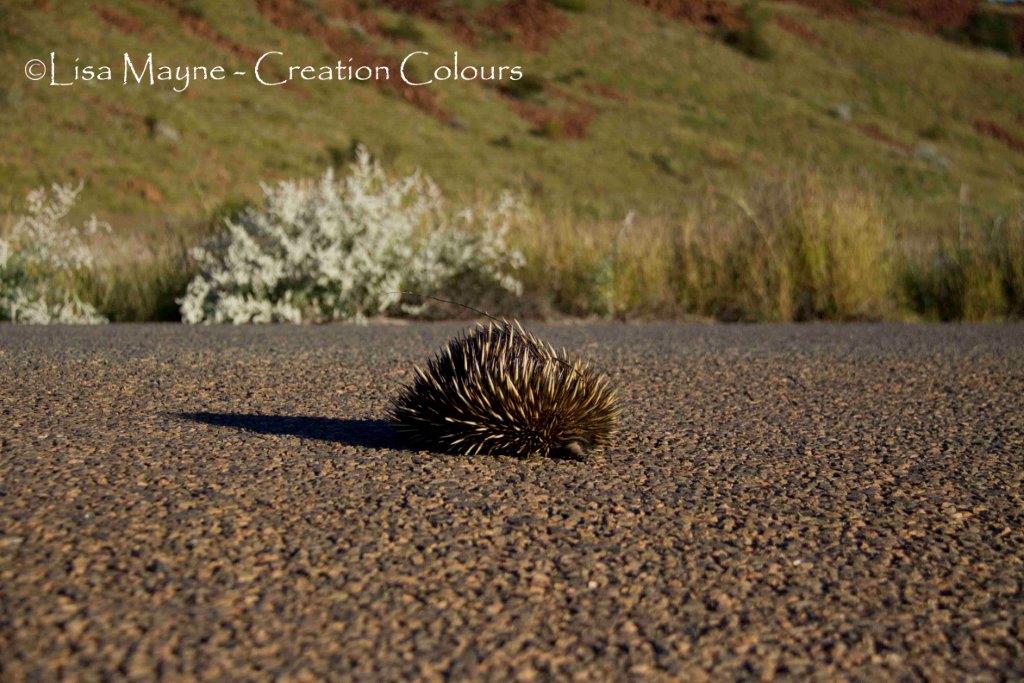
I was driving my little car along an outback road, when suddenly my tires nearly burst thanks to the little guy below running out onto the street! I slowed down, the guy coming the other way stopped, and I raced out with my camera, and my grandmother’s camera who was visiting at the time. Of course, I wasn’t first to the scene of the terrified echidna, but I think my Betsy managed to intimidate the other onlookers a little…oops, that’s really not meant to happen!

So here I am, crouched down on a road where the speed limit is about 80km an hour. It’s a popular road on a weekend as it leads to a nice little cove. Two cars had to swerve to the other side of the road to miss me. I’m sure they thought I was quite mad but let’s face it: you don’t want to hit one of these guys with your car!

Pilbara Echidna. Canon EOS 50D f/4.5 1/6400 shutter, ISO 500, +1 Step, 50mm, shutter priority setting. So this picture is boringly composed - who puts the subject almost of dead centre? - but I like it because it shows the echidna literally in the middle of the road, with the gorgeous Pilbara colours behind and even a bush of some wildflowers! Plus I like how the echidna is in focus. Why does he have a stick on his back I wonder? Fancy Dress? Not likely.

Canon EOS 50D f/5.6 1/6400 shutter, ISO 500, +1 Step, 110mm, shutter priority setting. I like the shape of the echidna in this picture, and the pattern his spikes make. I'm still confused about the spike - I wasn't game enough to remove it on the day, I'm a chicken! The only thing that could have improved this picture is getting his eye. I only caught a brief glimpse of it, but my father always said when photographing wildlife, get the eye in focus or else it's worthless! And the threat of speeding traffic should be no excuse, not to the real amateur photographer!


Normally I would remove such a gorgeous creature out of the way on my departure (generally by chasing it, yes) but to tell you the truth I was a little intimidated by those spikes! When left alone however, he quickly scampered off into the bush so no harm done. Well other than the fright of its life!

At the end of the day, if it moves it’s difficult, but if it refuses to move out of shear fright it’s fair game!