Wednesday, February 26, 2014

Tranquility in Tigre

To escape hectic-ness in Buenos Aires we took off to Tigre, which is on a spectacular delta with whole suburbs only accessible by boat. We were graced with hummingbirds, the best bed and breakfast I have stayed in (I very nearly stayed forever), and a sweet town on the river.

We toured the delta, walked around the town and drank matte. Here are a few photos from that blissful getaway! Again, you will notice the portrait theme happening...

Taxi - how to get around the delta. Canon EOS 50D f/9 1/1600 ISO 500 70mm

Canon EOS 50D f/9 1/1600 ISO 500 200mm

Art Museum along the river, had the most picturesque pillars. Canon EOS 50D f/9 1/1250 ISO 500 18mm

First attempt catching fish! Little difficult in the shade, and again, should have maybe put on shutter priority! Canon EOS 50D f/5.6 1/500 ISO 500 20mm

Smooth sailing through a tunnel of trees. Canon EOS 50D f/5 1/500 ISO 500 50mm

Sunday, February 23, 2014

Happiest Place on Earth: Part 2

I think everyone is in agreeance that waterfalls are cool. That they make people happy. The second part to this happy place though is a little more subtle but no less incredible.

The place was filled with butterflies.

I love butterflies.

I love to take photos of butterflies.

I was in heaven!

Because the butterflies loved me! I had three on me at one stage - I had them landing on my camera, obliging for my smartphone even! I have a rule on Instagram - I don't put any SLR photos on there, just ones from my Samsung because I believe loading an SLR picture defeats the purpose. Instagram was happy that day! At first I was just snapping away on the smartphone, but eventually I was just walking around with my SLR because they were just prolific.

Here are a couple. Some are obviously from the smartphone and others are from the SLR. I hope this rainbow of butterflies brings you as much joy as they brought me!

Samsung Galaxy - not bad for a smartphone hey!

Samsung Galaxy - butterfly love!

Possibly a favourite - also from the Samsung - two of my greatest loves!

And now we are down to business...Canon EOS 50D f/10, 1/200, ISO 250, 140mm

I just love that this guy has transparent wings! Canon EOS 50D f/5.6, 1/50, ISO 500, 200mm
Happy as a butterfly in mud! Canon EOS 50D f/5.6, 1/250 sec, ISO 1250, 200mm.

Saturday, February 22, 2014

Happiest Place on Earth: Part 1

Don't get me wrong, I am not trying to take any glory away from Karijini. But Iguazu Falls would have to be one of the happiest places on Earth. There are two reasons for this - the first is that they are awesome waterfalls (and by the way, the use of the word 'awesome' is one of the few times the word is appropriate if it is not being overused - they are magnificent). The second I will share with you in part two.

Waterfalls? you might ask. What does them being waterfalls have to do with anything? Well, for one, they are massive. But for the second, they create what's called negative ions - nature's endorphin! When you stand at the bottom of these falls, you literally cannot stop smiling - even laughing.

Canon EOS 50D f/13 1/160 ISO 250 18mm 
EOS 50D f/11 1/200 ISO 250, 18mm
 This is only one, teeny tiny part of the falls. As we were on the Argentine side we didn't get a huge panorama, but it was a lot of fun just walking around these incredible falls, looking over the edge, looking up, feeling the spray. Just amazing. Amazingly happy.
EOS 50D f/13, 1/160, ISO 250, 18mm
 This photo I love - because it took me by surprise! I love it when that happens! It is actually the first of a five picture panorama. I stitched them together and it didn't quite work, but I fell in love with this one because of the water running through the greenery. Just like a magical paradise.
Canon EOS 50D f/13 1/160, ISO 250, 28mm
Finally, another of my favourites. Although the water is not misty I hope you still get the sense of movement (I do, but that could be because I was actually there and I am really just remembering being there). I just want to smile when I see this photo because they were such incredible falls, it was a beautiful day and standing here for any amount of time was guaranteed, 100% to make you happy. I hope it brings a smile to your face as well.


Saturday, February 15, 2014

Kakaw! Kakaw! Tookie Tookie!

"Ah Wayne? I think we have established that 'kakaw kakaw' and 'tookie, tookie' don't work!"

I apologise profusely but unashamedly for the title. I do tend to get obsessed with random things and over my life they seem to have built up somewhat. The above was all I could think about. It is a line from the comedy movie Evolution which I found to be hilarious at one time (who doesn't want to see the guy from the X Files blow up a bunch of nasty aliens with anti-dandruff shampoo?)

It is however partially relevant to this post. We have reached Argentina on the South America trip. The first thing we did upon arriving in Buenos Aries (after we ate a 380g steak each, accompanied by red wine and then slept) is take off to the northern border with Brazil to visit Iguazu Falls. These falls are spectacular and are in the rainforest - complete with tapirs, jaguars and toucans.

And what did we happen to see within the first ten minutes of being there? A toucan, whoo! They are pretty awesome birds - vivid and enormous beaks.

The unfortunate side to this story is that we were kind of rushed. Now, you regular readers would know of my rule of not photographing things that move because it's too hard. That's actually kind of a lie. If it was up to me, I would have chased that thing all morning. The reason I tell myself not to is because it is inevitable that I become depressed.

We were on a guided tour and we had to catch a train on time, so I couldn't spend too long chasing it. I didn't exactly sneak up either so what happened? The inevitable - it flew away. Several times. Plus I was having to continually adjust my settings - auto was too bright but for the life of me I could not run, watch the toucan and adjust the settings in time.

In the end I managed to snap proof that we saw a toucan, but not much more. The photos are grainy because they were irreparably dark. Insert sad, disappointed face. Lifetime opportunity of photographing a toucan in the wild = missed. At least I have proof we actually saw one!

Toucan at Iguazu. Canon EOS 50D, f/10, 1/1250 shutter, ISO 500, 200mm. Cropped and edited in Photoshop. The high ISO would not have helped the grainyness, and I should have lowered the aperture I'd say. You live and learn.

Canon EOS 50D f/10, 1/800 shutter, ISO 500, 200mm. Ahh Why on earth did you adjust the shutter??? 
Clearly I need some strong lessons in Exposure. Something to be rectified in 2014...


Saturday, February 8, 2014

Sky heights and Canyon depths

We were lucky to visit the Colca Canyon, which is over 3000 meters deep making it the deepest canyon in the world. Surrounded by cactus and condors this was a really interesting part of Peru.

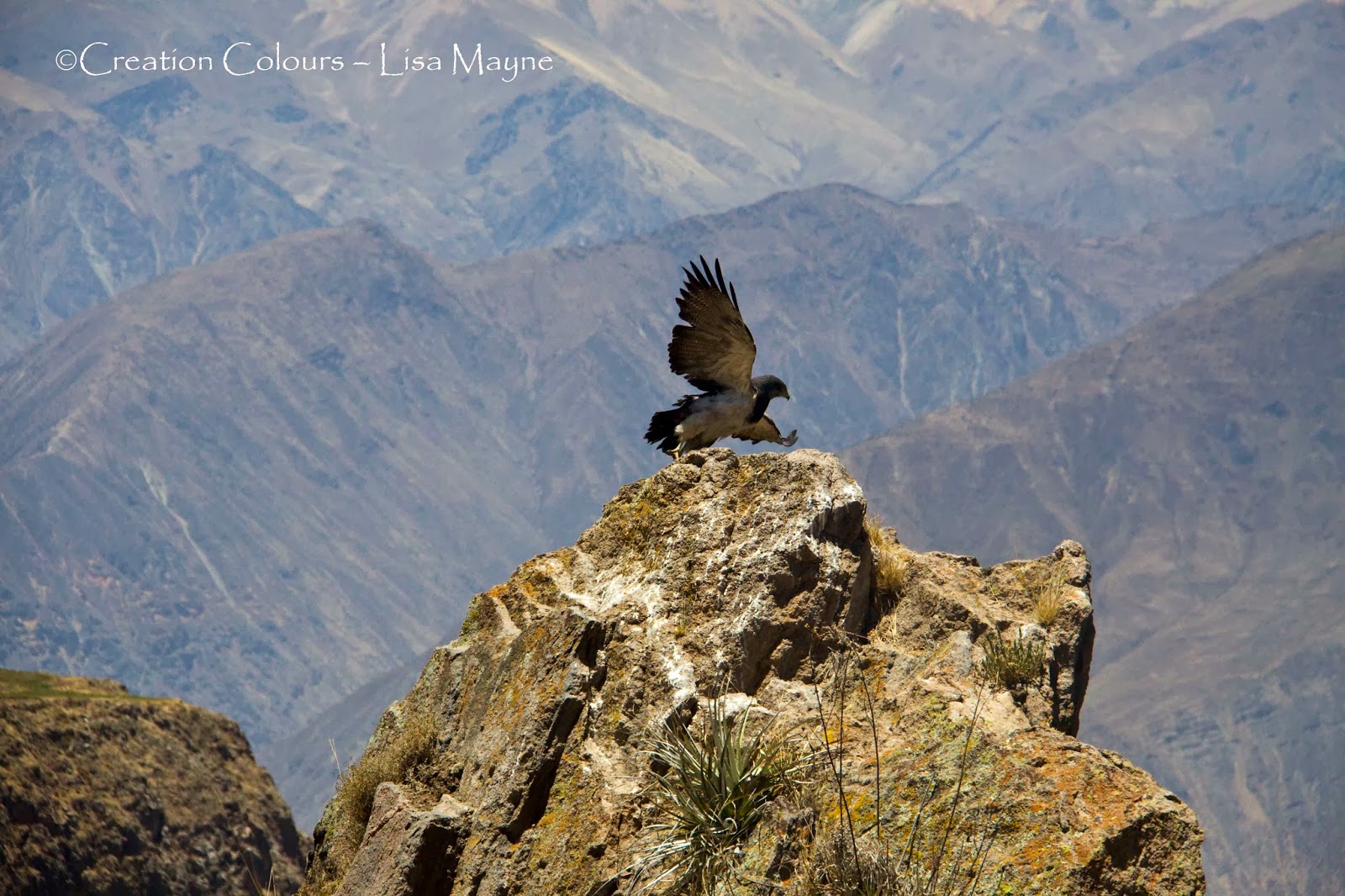
We saw a condor, had one fly overhead while having lunch. We were also treated with an eagle taking off. I've not had too much success with flying birds, but at least I have learnt that a fast shutter speed is king!

Colca Canyon. The terraces on the right are pre Inca. Canon EOS 50D, f/8, 1/1600, ISO 500 18mm

Eagle taking flight at the Colca Canyon. Canon EOS 50D f/8, 1/2500, ISO 500, 130mm

Condor overhead. I had it already set from the eagle shot. Canon EOS 50D f/8, 1/2500, ISO 500, 200mm, cropped. 

Monday, February 3, 2014

Macro Meandering

The second lens I purchased in January is a Canon 100mm Macro lens. I tossed up between this one and the L series which to be honest with you, would have been awesome. Just an extra few hundred dollars. For what I do, I didn't think I needed it.

Now, I have always wanted a macro lens. It has been top of my list forever. When I bought my first camera to get into photography, I just used the macro setting most of the time. It is something I want to get good at.

Canon EOS 50D f/16, 1/250, ISO 100, 100mm
These are just a couple of shots I got down at Cleaverville Beach on the Australia Day holiday. I am still getting to know the lens, but it was great fun to go down and experiment!

Canon EOS 50D f/3.2, 1/1250, ISO 100 100mm

Canon EOS 50D f/3.2, 1/1250, ISO 100, 100mm


Canon EOS 50D f/16, 1/160, ISO 100, 100mm

Sunday, February 2, 2014

Wide Wanderings

One of my new lenses is the Canon 10-22mm wide angle lens. I haven't used it a great deal but I know that I love it. I don't think I will ever go back to using my 18-200mm unless I need the zoom! You can just get so much more in the picture!

This year I am also going to be working on my composition - trying to take attractive and interesting photos. So far, this has been fun with the wide angle - I particularly love getting so much sky. I'm not sure why, but I think it's because it creates a sense of an expanse.

I went down to Cleaverville beach for an experiment on the Australia Day holiday. There wasn't too much there for the wide angle unfortunately, but I thought I would share some with you so you can see what I mean.

Canon EOS 50D f/4.5 1/1250 ISO 100 22mm. I know, it's just another desert pea. But I like this shot because almost the whole plant is in focus, while the grass behind isn't. Yes I was on my belly for this shot. 

Canon EOS 50D f/10, 1/250, ISO 100, 11mm

Saturday, February 1, 2014

Architecture Composition Challenge

I've never really been one for taking photos of buildings. I think they are beautiful, but the beautiful kind are rather in short supply in the Pilbara. (I'm sorry but it's true! Modern architecture does nothing for me, I find it depressingly dull).

Now, I know absolutely nothing about architecture. Or building, or in fact, design of buildings. But I know when I see one that's beautiful. It doesn't even have to be functional! Just beautiful.

I also know that they are kind of hard to take photos of, especially at close range. In my own typical fashion I did no research on composition before going to South America and decided instead to just wing it, as you do. Some were good, some not so good, some were OK once they had been through the editing process.

See, when looking through a lens on a building at close range, the straight lines become skewed out of proportion. I have read tutorials on how to correct this in Photoshop (making parallel lines actually appear parallel and so on) but it's quite difficult to apply to your own photos. I've found myself thinking back to 'did it actually look like that?' several times. The horizon straitening tool in Adobe RAW came in very handy for these images.

Another thing I didn't notice until I was going through my photos post-trip is that I took an extraordinarily large number of photos in the portrait orientation. For some reason, I found this easier to compose than landscape. When taking photos of buildings it is good to have parallel lines and seeing as buildings go up, the photo goes up as well. I also found it was good to incorporate a building corner and try to have something in the foreground.

I should write down composition as a goal for 2014 - it has never really been my strong point, I've always just sort of pointed and shot what I thought looked good and hoped for the best.

Museum in Cusco. Classic Spanish inspiration. Love the plants as well. Canon EOS 50D f/8, 1/640 ISO 320
 We were surprised at the level of Spanish influence throughout South America. As we have never been to Europe, we felt like we were in Europe. Beautiful oil paintings, old buildings, cathedrals. In Cusco it was interesting because Cusco being the ancient Inca capital, was torn down by the Spanish who then proceeded to build the city on the same site with Spanish architecture and local rock and labour. Classic example is below.
Quikancha (Temple of the Sun) and the Church of Santo Domingo. Canon EOS 50D f/8, 1/250, ISO 320, 18mm.
 This church actually made me feel funny. I know that's not a very eloquent sentence but it was true. Peru in general made me a little uncomfortable, particularly Cusco. Let me explain - a warning, this is going to get a little less light-hearted and a little more serious. The dark rocks in the above photograph are what remains of the Inca site Inti Kancha or the Inca Temple of the Sun. It was demolished by the Spaniards and replaced with a Cathedral dedicated to Santo Domingo. Inside the Cathedral are beautiful carvings covered with gold filigree, statues of Christ, intricate alters, paintings and other beautiful works of art. Our tour guide told us a story of one of the statues of Christ, who had been blackened by the candles (apparently) and how the Peruvian people worshiped him as Lord of the Earthquakes because of an incident when an earthquake stopped once the statue was brought outside. I couldn't help but think, 'this isn't the Christ I know.' This was the only recognition I saw in that country of any kind of belief in Christ, the rest of the church was dead. Spiritually dead. And so much money just sitting there in the gold with people begging on the streets. All for what? A God that the local people didn't believe in? Wouldn't God want that money to be used to build up those people, to bring healing? It was then that I realised that Christianity truly is a grassroots movement and cannot, CANNOT be implemented by any Government decree, by force, or by invasion. It doesn't work. On top of this, the cathedral was built on the foundations of the most sacred site to the Incas, the Temple of the Sun. A site considered more sacred to the local people than the church itself, a site that is better constructed than the church itself (the church fell down in the above mentioned earthquake, the temple of the sun did not). It made me sad, that the builders on this church would even associate Christ with any Inca beliefs, and would appear to try and just replace their beliefs and secondly, it was so empty! It was a museum, not used except at Easter time. It was very saddening and had a very profound impact on me as I walked through that place, it made my heart cry out for these people.

Moving on from Cusco, we visited Arequipa. Arequipa is the economic hub of Peru, it is shadowed by volcanoes and is built with white volcanic stone. It is rather an impressive city. While we were there there was some kind of rally going on at the town centre (the Spanish loved their central plazas!) so I didn't take my SLR out much. We did visit St Catalina Monastery. This was incredibly interesting. It was one of the richest monasteries in the world and has now been opened up as a tourist site. Nuns still live there, only not in the tourist section, in another section. They are not allowed to live in luxury anymore and hence, the number of nuns has dwindled. Still it was a fascinating place to visit! It is probably the place I had the most fun snapping away at the buildings as they were really interesting colours.
Canon EOS 50D f/5, 1/250, ISO 500, 18mm
Canon EOS 50D 1/640, ISO 500, 18mm
Canon EOS 50D f/4.5 1/125 ISO 500, 24 mm

Canon EOS 50D f/6.3, 1/1000, ISO 500, 18mm

Friday, January 31, 2014

January Experimenting

So I realise that in my zeal for posting about South America I have neglected to share some of my experiments for January! And since today is the 31st and also a Friday I thought I might give you a little, fresh off the lens teaser!

That's right ladies and gentlemen, I am now the proud owner of two more lenses! I live life by extremes - so the 100mm macro and the 10-22mm wide angle are two completely different but equally awesome additions to my humble collection!

So, I would like to share with you my latest experiment. Since being here I have always wanted to go down to Dampier at night and take photos of the lights. I finally managed to do this this week!

In half an hour I got one photo I was pleased with - even still it is a little soft. I need to do a bit of research on getting the most out of my lenses.  I used a tripod but found it very difficult to focus on the right place without moving the camera slightly as soon as I took my finger off the button. It's a pity I didn't have my remote with me.

Anyway, for my first attempt at industry lights, I didn't think it was too bad! With the Macro and all!

Happy Friday!

Dampier Port - never sleeping. Canon EOS 50D, f/16, 10 second shutter, 100mm on a Canon EF-S 100mm Macro lens

Wednesday, January 29, 2014

Flower Pots and Windows

It's not often that something random tickles my fancy. Well, it is, but not often am I able to express my fancy in a photograph. At the St Catalina Monastery in Arequipa, Peru, there were heaps of geraniums and other plants in flower pots attached to the windows. The whole place was quaint and inspiring and I guess these plants are what really set it off for me. I took a couple of photos of them, and I don't quite know what it is about them, but they just make me happy to look at them. I guess you could say they are aesthetically pleasing. 

Canon EOS 50D f/6.3, 1/250 ISO 500, 18mm

Canon EOS 50D, f/6.3, 1/500, ISO 500, 18mm

Saturday, January 25, 2014

Mountains, Valleys and Llamas

Nothing says South America like mountains and llamas. While hiking the Inca Trail we were treated to both. When stopped on the second day (remembering the second day was the 1200m up in 10km day) we stopped for a break at a spectacular lookout. Exhausted and sore, we slumped on a rock, convinced we would not be able to walk another step and grateful for the break (we were about halfway up the climb). Our guide then proceeded to point out a flock of llamas 100-200m away. Fatigue was instantly gone and most of us raced over to stalk the llamas with cameras.

I managed to take a photo of one member of our hiking group walking towards a llama to take a photo of the llama spitting him. Got him too - they both did! Hubby got spat at a bit as well. Me? I kept out of the way of llama spit, and I did manage to capture some images that I feel scream 'I'm in the Peruvian Andes!'

Lazy llama - this guy watched me coming and didn't move for ages. He kept giving me the look of 'do I have to? Are you really going to make me move?' Canon EOS50D, f/9, 1/1250, ISO 320, 200mm

I'm in the Peruvian Andes! Canon EOS 50D f/9, 1/1000, ISO 320, 32mm.
Hiking and camping in the Andes along the Inca Trail was pretty spectacular. There are three snow capped mountains in the area that we saw the peaks of at various times. Also the flora and the way it was constantly changing from cloud forest, to grasses, to wild-flowers to scrub was exciting.

Mount Veronica. Our view from night one's campsite (albeit rather zoomed in!) Canon EOS 50D f/5.6, 1/400, ISO 125, 200mm

Red flower at our first campsite. Canon EOS 50D f/5.6 1/400, 110mm
And of course. Who doesn't love a baby llama? This guy was wandering around the third pass on day three. With mum of course, but she was no where near as obliging to the lens. I had to lighten his face considerably in Photoshop but his ears more than make up for it.
Baby Llama. Canon EOS 50D, f/5.6, 1/2000, 135mm. 

Saturday, January 18, 2014

People of Cusco

I've never been acquainted with Peruvians before Cusco and I must admit there was an element of culture shock to our visit. Mostly, South Americans are very friendly people. Around Cusco you get a real sense of Inca pride and although this is quite interesting at first, we started to grow weary of it. It may have something to do with feeling as though people are only after the tourist dollar. Peru is not very rich and we couldn't help but feel that tourists are seen as a bit of a cash-cow.

Never the less Cusco is a great place to visit. Highly interesting and architecturally very unique. Inca ruins mixed with Spanish influence - doesn't come along every day.

One thing is the people who are willing to be photographed - for a fee of course. I don't do a lot of portraiture. Frankly, people just don't behave like rocks do. But I did manage to take a couple that I liked.

Artisan weaver. I bought a beautiful table cloth from this lady. I love how she is sitting on such colourful materials. Canon EOS 50D, 1/125, f/6.3, ISO 100, 28mm. 


Another Artisan weaver at the National Museum. Canon EOS 50D f/4.5 1/60 ISO 100 35mm

Monday, January 13, 2014

P.S. - Panorama Spectacular - Machu Piccu

While in South America, I took many panoramas. I reiterate, many, many panoramas. Some good, some, not so good, others a little weird, but all I had to wait until I returned to my trusty laptop before I could ascertain their status. I managed to get panoramas of all the highlights. More than one of most. So, after my mammoth post on Machu Piccu, I present a post-script - panorama spectacular! (Although I warn, not all are spectacular, I just needed a word that started with S)
Ok, so this isn't Machu Piccu, but it is on the way on the  Inca trail! Also, low resolution affects quality. Ruins to the left are pre-Inca. 

I got a number of versions of this, this one being the best, other than a slight slant to the left. Pretty awesome view though.


Saturday, January 11, 2014

Ruined by Ruins

Some have asked me, why South America? Simple. For our first major holiday, my husband chose an adventure (which I very quickly agreed to because it was an awesome idea) and the result was this. It was now my turn to choose and I chose the one place I have always wanted to go - Machu Piccu. I have always been intrigued by ruins and ancient cultures...and ruins on top of a mountain sounded pretty inspiring so naturally it has always been top of my list. As it is right on the other side of the world, naturally we decided to make the most of it, max out our leave allowances and explore as much of the continent as possible. More on that later; today I'm showing you some Inca ruins.

Unfortunately, as previously mentioned this was not a photographic holiday per say, and to keep my adventurous nature and my husband happy I arranged to hike the Inca Trail during our first week. This is a four day hike over 42km along parts of the original trail to Machu Piccu. The highest point on this trail is the first pass, 4200m above sea level. Now, I'm not the world's most fit person and I've got to tell you that the second day of the Inca trail, 10km climbing 1200m, is the hardest 10km I have ever done in my life! Altitude sickness plus jet-lag. Not a great combination!

Before the photos, a brief history lesson: Machu Piccu was built by the Inca in approximately 1450, sitting at a 2,430m (8000ft) above sea level. It was abandoned before it was completed due to the Spanish conquest in 1532. Machu Piccu however, was never discovered by the Spanish due to the Quechuan people hiding its whereabouts by destroying some of the paths and allowing the jungle to take over. In theory it was built as a sanctuary for the Inca Pachacuti, although in reality no-one really knows. It sits, literally, on top of a mountain among other mountains. It is an amazing accomplishment for a civilization. The Inca truly were the world's first mountaineers.

Machu Piccu from Huayna Piccu (the great big steep mountain you see in pretty much every photo of Machu Piccu - word to the wise - don't climb it in the rain!) Canon EOS 50D f/4, 1/1250, ISO-320, 32mm. 
The above photo was taken from Huayna Piccu - the steep mountain you see behind Machu Piccu in almost every photo. There are ruins up there as well, although how the Inca's built them I will be forever wondering! At least Machu Piccu can be explained by the rock quarry in the middle of town; Huayna Piccu can only be explained by people carrying rocks up an incredibly steep, incredibly narrow and an incredibly slippery trail! It started raining when we were halfway up. It's rather daunting when you are on a narrow staircase on the side of a mountaintop of ancient ruins, looking down into the valley below knowing that each drop of rain is making you more vulnerable. No handrails and no trampolines below. I never understood why some people fear heights properly until the day we climbed Huayna Piccu. The consequence of this fear translated into a lack of photos. We were pretty keen to get down when all said and done.


Staircase leading to ruins along the trail. Original Inca. Canon EOS 50D f/8 1/500, ISO 320, 18mm.
So, Machu Piccu was never discovered by and therefore ransacked by the Spanish and it wasn't until a man named Hiram Bingham discovered the Inca site in 1911 that it became known to the world. (It was also discovered by some local Peruvians who were living at the site at the time). Hence, it was relatively in tact despite being incomplete and has been voted as one of the Seven New Wonders of the World (2007). Today, people are still discovering Inca sites all through the Andes along original Inca trails.

Machu Piccu plus fog. Canon EOS 50D f/5.6, 1/1250, ISO 320, 40mm. 
Unfortunately the day we were in Machu Piccu, so was a considerable amount of fog. It meant I could not get the one shot I went to South America to get guaranteed to impress: the classic lookout of Machu Piccu with the Huayna Piccu mountain in the background. I had to settle for shots such as the above. The place is still incredibly impressive. The people who lived here I believe were privy to the most inspiring view on earth. Imagine waking up to this every day?

Machu Piccu and the Mountain. Canon EOS 50D f/3.5, 1/2500, ISO 320, 18mm.
Of course, as you can see above, these days the place is swarming with people - tourists, students, guides, archaeologists and of course, camera nerds. Photographers everywhere! Makes it hard to think you can get any shots that are unique and worth a damn. In the end I had to settle for just opening my eyes, enjoying the moment, recognizing Machu Piccu for the great human accomplishment it was; ultimately built to celebrate this creation.  In the end, my favourite photos from Machu Piccu ended up being these two, of a small flower growing out the side of one of the ruins. It reminded me that despite our best efforts, nature finds a way to persevere. God brings beauty to all things in their time.

Inca Flower, on the trail. Canon EOS 50D, f/8, 1/800, ISO 320, 200mm

Nature conquers Inca steps. Canon EOS 50D, f/8, 1/800, ISO 320, 100mm.